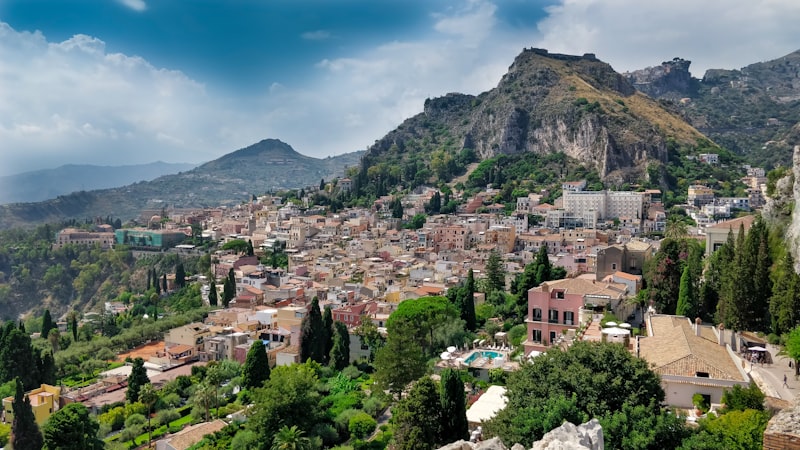
Taormina is a hilltop town on Sicily's eastern coast that has captivated visitors since the ancient Greeks built a theater here in the 3rd century BC. Perched 200 meters above the Ionian Sea with Mt. Etna looming to the south and a turquoise coastline stretching in both directions, it offers American retirees a Mediterranean lifestyle steeped in history, extraordinary food, and one of Italy's most favorable tax regimes for foreign pensioners.
Why Retirees Are Choosing Taormina
Taormina combines three things that are hard to find together: genuine cultural depth, natural beauty on a grand scale, and access to Italy's modern infrastructure. The ancient Greek Theater, still used for summer performances, frames a view of Mt. Etna that has been called the finest panorama in the Mediterranean. The Corso Umberto, the town's pedestrian main street, is lined with Baroque churches, sidewalk cafes, and boutiques occupying buildings that have stood for centuries.
Unlike many retirement destinations that require compromise, Taormina delivers European healthcare, fast internet, reliable infrastructure, and easy access to a major city (Catania is 50 minutes away) while feeling like a timeless village. The pace of life revolves around the morning espresso, the afternoon passeggiata, and long dinners with local wine from Etna's volcanic slopes.
Cost of Living
Taormina is not the cheapest place in Sicily. Its reputation as a luxury tourism destination means prices are higher than in Catania, Palermo, or smaller Sicilian towns. However, by American standards, it remains remarkably affordable for what you get. A retired couple can live comfortably for around $2,670 per month, including a centrally located apartment, regular dining out, and a car for exploring the island. Budget-conscious retirees can manage on approximately $1,680 by living in nearby Giardini Naxos, while those seeking a premium lifestyle with sea-view terraces and fine dining will spend around $4,380.
Housing
Long-term rental prices in Taormina vary significantly based on location and season. On an annual lease, a one-bedroom apartment in the town outskirts or in neighboring Giardini Naxos (the beach town directly below) starts around $900 per month. A two-bedroom apartment in Taormina centro with partial sea views runs $1,200-$1,600. Luxury apartments and villas with terraces overlooking the bay and Etna command $2,000-$2,500. The key is securing an annual lease rather than seasonal tourist pricing, which can be three to four times higher in summer.
Food
Sicilian cuisine is among Italy's finest, and Taormina's markets and trattorias showcase it daily. Fresh swordfish, sardines, and sea urchin come straight from the Ionian coast. Arancini (fried rice balls), pasta alla Norma, and cannoli are local staples available for a few euros. A full meal at a neighborhood trattoria costs $12-18 per person with house wine. The daily market in nearby Giardini Naxos offers fresh produce, cheese, and cured meats at local prices. Groceries for two run $250-350 per month depending on how often you buy imported products versus local Sicilian ingredients.
Key Takeaway
Taormina is a premium destination by Sicilian standards, with costs roughly double those of Catania or Palermo. However, a couple living on $2,670 per month enjoys a lifestyle that would cost $5,000-$7,000 in comparable coastal towns in California or the French Riviera. The real savings come from securing annual leases, shopping at local markets, and eating where Sicilians eat.
Healthcare
Italy's national healthcare system, the Servizio Sanitario Nazionale (SSN), is consistently ranked among the best in the world. Legal residents who register with the SSN receive a tessera sanitaria (health card) and access to a primary care physician, specialist referrals, hospital care, and prescription medications at nominal cost. Most GP visits are free, and specialist consultations typically cost $30-50 through the public system.
Taormina has a local ASP health clinic, while Catania, 50 minutes south, has several major hospitals including the Policlinico Universitario and private clinics with English-speaking staff. For most routine and moderate medical needs, the local infrastructure is more than adequate. Serious surgical procedures or rare specialist care may require travel to Catania, Messina, or mainland Italy, but the public system covers these referrals.
Visa and Residency
The primary visa for American retirees is Italy's Elective Residency Visa (Visto per Residenza Elettiva). This requires proof of stable passive income of at least approximately EUR 31,000 per year for a single applicant (about $2,583/month), rising to EUR 38,000 for couples. Income must come from pensions, Social Security, investments, or rental properties. Employment and remote work are strictly prohibited.
The application is submitted at the Italian consulate in your US jurisdiction and typically takes 3-6 months to process. You will need proof of income, health insurance valid in Italy, a lease or property purchase agreement, and a clean criminal record. Once in Italy, you register with the local comune (municipal office) and the questura (police) to obtain your permesso di soggiorno (residence permit), which is renewable annually. After 10 years of legal residency, you become eligible for Italian citizenship.
Tax Considerations
Italy offers one of Europe's most attractive tax regimes for foreign retirees. The 7% flat tax allows qualifying pensioners who move to a municipality with fewer than 20,000 residents in southern Italy (including Sicily) to pay just 7% on all foreign-sourced income for up to 10 years. This covers pensions, Social Security, investment income, and foreign rental income. Taormina's population of approximately 11,000 qualifies for this program.
Under the US-Italy tax treaty, Social Security benefits are generally taxable in the country of residence. US citizens remain subject to US taxation on worldwide income, but can claim Foreign Tax Credits for taxes paid to Italy, largely preventing double taxation. The combination of Italy's 7% flat rate and US Foreign Tax Credits makes Taormina remarkably tax-efficient for pension-funded retirement.
Language and Culture
Italian is essential for daily life in Taormina. While tourist-facing businesses along Corso Umberto often have English-speaking staff, navigating the healthcare system, dealing with municipal bureaucracy, and building relationships with neighbors all require at least conversational Italian. Many retirees take Italian language courses at schools in Taormina or Catania, and the language is considered one of the easier European languages for English speakers to learn.
Sicilian culture rewards those who invest in it. The pace of life is slower and more social than most Americans are accustomed to. Neighbors become friends, the barista knows your order, and local festivals celebrating patron saints, harvest seasons, and religious holidays create a strong sense of community throughout the year.
Climate and Seasons
Taormina has a classic Mediterranean climate with hot, dry summers and mild, wet winters. Summer temperatures typically reach 82-88 degrees F from June through September, moderated by sea breezes at Taormina's elevation. Winters are mild, with lows rarely dropping below 46 degrees F, though rain is frequent from November through February. Spring and autumn are arguably the best seasons, with comfortable temperatures, fewer tourists, and the surrounding hillsides in bloom.
The seasonality of tourism is important for residents. Taormina is bustling from May through September, with the famous Taormina Film Festival in June and concerts at the Greek Theater throughout summer. From October through April, the town quiets down considerably, many tourist-oriented businesses close, and Taormina returns to its village rhythm. Most long-term residents prefer this quieter off-season personality.
Getting There
The nearest airport is Catania-Fontanarossa (CTA), approximately 50 minutes south by car or bus. Catania has direct flights to major European hubs including Rome, Milan, London, Frankfurt, and Paris, with connections onward to the US. Total travel time from Miami is typically 12-15 hours with one or two connections. The Interbus shuttle service runs regularly between Catania airport and Taormina.
Within Sicily, a car is highly recommended for exploring the island's coastline, mountain villages, and archaeological sites. The A18 motorway connects Taormina to Catania and Messina, and ferries from Messina cross to mainland Italy in 20 minutes. High-speed trains from Messina reach Rome in about five hours.
Key Takeaway
Taormina is best suited for retirees who want a culturally rich, visually stunning Mediterranean lifestyle and are willing to pay a premium over other Sicilian locations for the privilege. The 7% flat tax regime, excellent healthcare, and Italy's deep cultural offerings make it compelling, but success here depends on learning Italian, embracing the seasonal rhythms, and accepting that Taormina is fundamentally a small town that happens to be spectacularly beautiful.