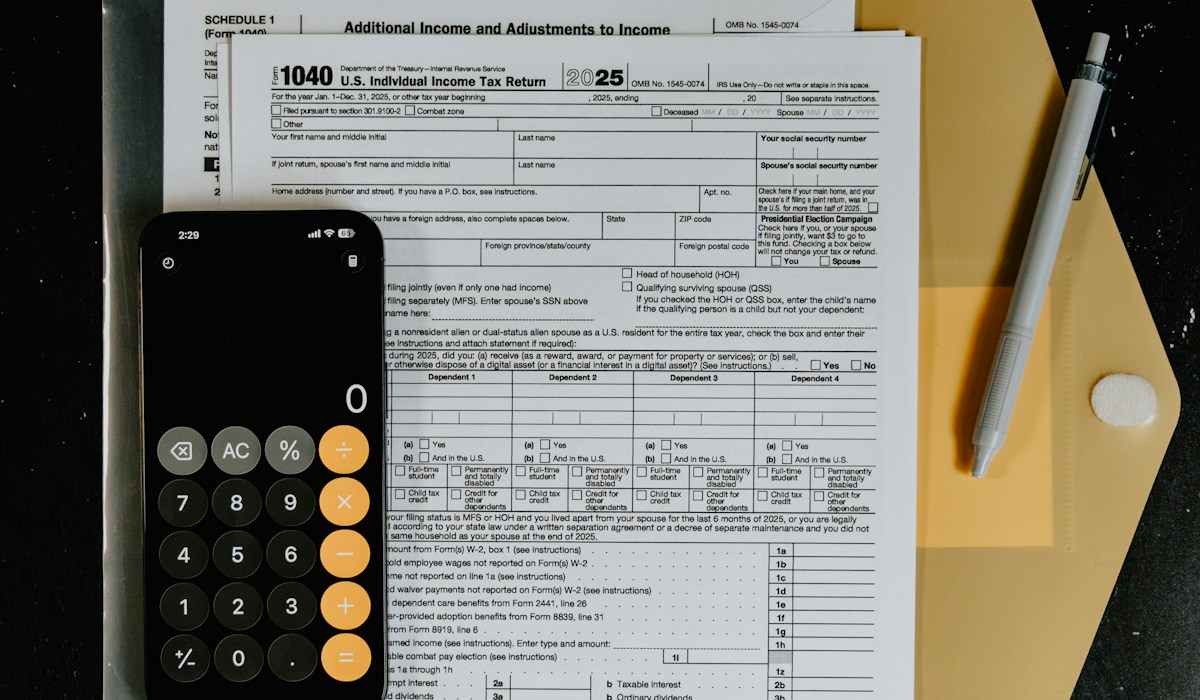
If you take a taxable IRA withdrawal late in 2026, will your custodian withhold enough federal tax? A default 10% withholding rate for many nonperiodic distributions is not a prediction of your actual tax rate. For retirees balancing RMDs, Social Security and portfolio withdrawals, the gap between the amount withheld and the eventual tax bill can be surprisingly large. Here is a practical way to review withholding before December 31 without confusing an RMD with the tax paid on it.
Key takeaway
Taking the correct withdrawal and paying enough tax throughout the year are separate jobs. Compare total expected federal tax with withholding already paid and any estimated payments; ask your custodian or tax adviser how to adjust before year-end.
The 10% default is not a tax-rate recommendation
For an IRA distribution payable on demand, federal withholding on a nonperiodic payment generally defaults to 10% of the taxable amount unless you have a valid election for a different permitted rate. The IRS's 2026 Form W-4R explains how to request a different percentage; an existing election for payments that began before 2026 generally remains in effect until you change it. By contrast, an eligible rollover distribution paid to you from a qualified retirement plan is generally subject to 20% default withholding, and Form W-4R does not permit electing below 20% for that type of payment. An RMD itself is not eligible for rollover. Do not generalize the IRA rule to every 401(k), pension, annuity or inherited account. Confirm how the payer classifies your distribution before submitting instructions.
A retiree who withdraws $30,000 from a fully taxable traditional IRA and leaves 10% withholding in place sends $3,000 to the IRS. That arithmetic does not say the final tax on the withdrawal is $3,000. The withdrawal may also affect how much of a Social Security benefit is taxable, interact with deductions, or change other income-driven costs. Another retiree might owe less than 10% after considering all income and credits. Work from the full return estimate, not just the percentage shown on the IRA distribution form.
Withholding versus the required withdrawal
An RMD is a minimum amount to take out, not a tax payment. The IRS says an RMD from a traditional IRA is generally included in taxable income, except for amounts previously taxed or otherwise exempt. If your required distribution is $30,000 and you instruct the custodian to withhold $6,000, ask how the account will report the gross distribution and net amount received. The $6,000 sent to the IRS generally comes out of the gross distribution; do not assume a $24,000 deposit means you missed part of your $30,000 RMD. Confirm account and tax-document treatment with the custodian.
Most ongoing RMDs must be completed by December 31. A special April 1 rule can apply to the first RMD, with a second distribution due by the end of that following year; the timing choice may put two taxable amounts into one tax year. If that is your situation, see Bullseye's first-RMD deadline guide before assuming an October withdrawal is your only obligation. Inherited accounts and employer plans may have different details: get account-specific advice.
Two separate checklists
First verify gross distributions satisfy each account's applicable RMD rules. Then estimate whether federal and state taxes have been paid adequately. A correct RMD does not automatically prevent an underpayment penalty.
How the IRS decides whether payments are timely
Federal income tax is pay-as-you-go. Withholding and estimated tax payments can satisfy that obligation, but their timing may matter. The IRS's underpayment guidance says most taxpayers avoid a penalty if they owe less than $1,000 after withholding and refundable credits, or meet a payment threshold tied to current-year or prior-year tax. In general, those thresholds are 90% of current-year tax or 100% of prior-year tax, whichever is smaller. A 110% prior-year threshold can apply to higher-income taxpayers; there are additional qualifications. This is a penalty-payment rule, not a promise that your final balance due will be zero.
The IRS's estimated-tax FAQ gives an important condition: if prior-year adjusted gross income exceeded $150,000, or $75,000 for married filing separately, the prior-year percentage can be 110%. The prior-year return generally must cover a full year. A taxpayer with variable income, a large gain, an inheritance or a one-time conversion should not use a rule of thumb as a substitute for a return projection. State estimated-tax rules may be different.
Timing deserves special attention in October. An estimated payment made late in the year may not retroactively fix an earlier quarter's shortfall. Federal withholding is generally allocated evenly to payment periods for estimated-tax purposes unless you establish its actual withholding dates, a treatment that can make a late-year withholding adjustment useful. But exceptions and elections matter, and a large year-end distribution may create costs of its own. Have a tax professional use Form 2210 where needed rather than assuming December withholding cures every earlier penalty.
An illustrative safe-harbor worksheet
Assume a couple expects $18,000 in 2026 federal tax and their 2025 tax was $16,000 on a full-year return. Assume they are not subject to the higher-income 110% prior-year rule and have no special annualization issue. Ninety percent of $18,000 is $16,200; the ordinary 100% prior-year amount is $16,000. The simplified target is the smaller amount, $16,000. If combined withholding and timely estimated payments total $14,000, the simplified payment gap is $2,000. Reaching $16,000 may avoid the underpayment penalty under those assumptions while still leaving a $2,000 tax balance when the $18,000 tax is finally reported.
Now assume the prior-year adjusted gross income instead triggers 110% of the $16,000 prior-year tax. That amount is $17,600; the smaller comparison is then $16,200, meaning the simplified target is $200 higher than in the first case. These are hypothetical return-level examples, not directions to withhold a particular amount on an IRA payment. Credits, special tax items and the timing of payments can alter the result. Check the current IRS instructions or consult a tax professional before relying on this illustration.
Avoid the wrong fix
Do not take an extra IRA distribution merely to create withholding without estimating the distribution's added income tax and possible Medicare IRMAA consequences. You may be able to change withholding on another eligible payment instead, but each source follows its own election rules.
What to collect before changing a withholding election
- Prior-year return: locate total tax and adjusted gross income; note filing status and whether the return covered the full year.
- Current-year projection: include wages, pension income, Social Security, IRA withdrawals, taxable gains, interest and applicable deductions and credits.
- Payments already made: collect wage, pension, Social Security and IRA withholding plus dated estimated payments. Avoid counting a planned payment as already made.
- Upcoming distributions: confirm gross amount, processing deadlines, taxable fraction, any RMD requirement and what the custodian actually allows you to elect.
- State obligations: run a separate state estimate where relevant; federal W-4R does not solve every state tax rule.
If you receive periodic pension or annuity payments, the payer may use Form W-4P for withholding elections; Form W-4R concerns nonperiodic payments and eligible rollover distributions. Your provider may have an online workflow rather than a paper form. Check when an election becomes effective and request a confirmation before making a time-sensitive year-end decision. The exact custodian processing date can differ from the date you submit the request.
Do not let an income decision create an IRMAA surprise
Higher modified adjusted gross income can increase Medicare Part B and Part D premiums in a later year. For many beneficiaries, the determination usually looks back two tax years, so a 2026 taxable IRA withdrawal may affect 2028 IRMAA rather than the 2026 premium. The taxable distribution itself, not merely the amount withheld, matters to that income calculation. Review what income counts for IRMAA before enlarging a distribution or adding a Roth conversion just to manage withholding.
A Roth conversion is separate from the choice of withholding rate. Paying conversion tax from a traditional IRA can reduce what reaches the Roth and may have other consequences; a qualified tax adviser can compare cash sources. Similarly, a qualified charitable distribution has specific direct-transfer rules; ordinary cash sent to a charity after you receive an IRA distribution is not automatically a QCD. See the existing QCD and RMD guide for that separate planning path.
Where Bullseye fits—and where it does not
Bullseye projects traditional-account RMDs, federal and state taxes, Social Security taxation, and potential Medicare IRMAA costs over retirement years. Use its retirement tax planner to understand how withdrawal size affects a longer-run cash-flow projection, and use Scenarios to test a different income year. These projections can help identify what to discuss with a tax professional before changing a distribution.
Bullseye does not file Form W-4R, determine your safe-harbor payment dates, or automatically choose an IRA withholding percentage. It is not a substitute for a 2026 return estimate or Form 2210 computation. Keep the custodian's withholding confirmation and your payment records separate from the projection. If you receive a large, unexpected gain or your income changes late, contact a CPA or enrolled agent promptly rather than relying on a retirement model to solve a tax-payment timing question.
Bottom line
Before year-end, check both the amount of each required withdrawal and whether your combined tax payments meet the applicable rules. A 10% default withholding election is a starting mechanism, not the right answer for every retiree. Model the entire year, verify the custodian can process any change in time and weigh future Medicare effects before taking an additional distribution. This is general education; tax elections and rollover rules require individualized professional advice.
Action this week
Gather your 2025 return, 2026 income and withholding records, upcoming IRA distribution details and state tax information. Ask your tax preparer which payment target and withholding method fit your facts before you instruct the custodian.
